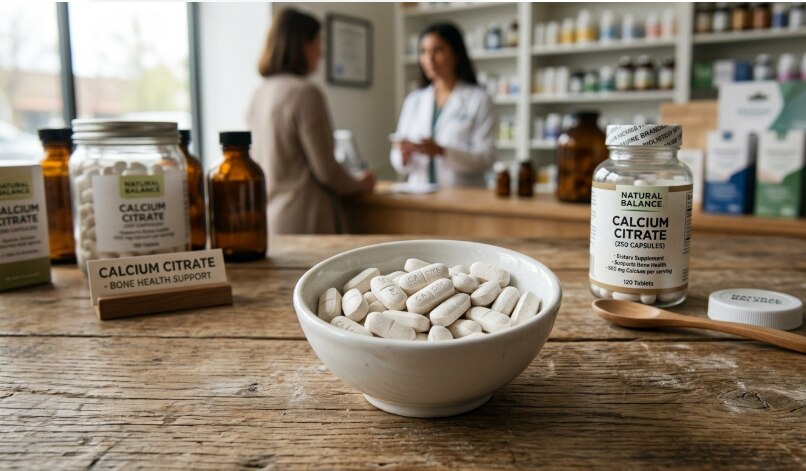
A calcium citrate purchase can fail before the material reaches your process: the quoted hydrate, assay basis, elemental-calcium value, or certificate may not match the specification you approved. By checking the chemical form, test basis, documents, contamination controls and packaging in sequence, you can reject mismatched lots before they create formulation, yield or compliance problems.
Key takeaways
- Name anhydrous or tetrahydrate calcium citrate before comparing quotations.
- Convert pharmaceutical grade into measurable identity, purity and impurity limits.
- Match every certificate result to your approved calcium citrate specification.
- Record packaging, batch traceability and transport conditions before shipment.
Confirm the hydrate before comparing price or assay
A quotation that says only “calcium citrate” leaves the purchase calculation incomplete. Ask the supplier to name anhydrous calcium citrate or calcium citrate tetrahydrate on the quotation, specification sheet and certificate of analysis.
| Form | Molecular weight | Theoretical calcium | Calcium at 98.0% assay |
|---|---|---|---|
| Anhydrous calcium citrate | About 498.4 g/mol | About 24.1% | About 23.6% |
| Calcium citrate tetrahydrate, C12H14Ca3O16 | About 570.5 g/mol | About 21.1% | About 20.7% |
Calculate theoretical elemental calcium by dividing the mass of calcium atoms in the formula by the molecular weight, then multiplying by the assay fraction. A 98.0% assay therefore does not deliver the same calcium from both forms. The tetrahydrate’s lower calcium percentage can indicate the correct water-containing form, not an inferior lot.
Ask whether the assay is reported on an as-is, dried, anhydrous or tetrahydrate basis. Record the water or loss-on-drying result with that same basis, and ask whether water was measured by Karl Fischer or loss on drying. Otherwise, comparing assay figures across different bases can create a false acceptance or rejection.
For a correct calcium citrate specification check, match the named hydrate, assay basis and calcium calculation before comparing price. Billing tetrahydrate quantity as anhydrous can distort formulation yield, required batch quantity and cost per unit of elemental calcium.
Turn “pharmaceutical grade” into an approval specification
“Pharmaceutical grade” is not an approval specification. Name the governing standard and edition—IP, USP-NF, BP or Ph. Eur.—and require the supplier to identify each monograph test, acceptance limit and method used. Add customer-specific requirements for a formula; USP alone does not prove suitability.
| Intended use | Add to the specification | What goes wrong if omitted |
|---|---|---|
| Dry blend | D10, D50, D90, bulk density, flow and blend-uniformity limits | Segregation can produce uneven active content |
| Tablet | Particle-size distribution, flow, compressibility and moisture limits | Feeder performance, weight variation or compaction can fail |
| Suspension | Wetting time, dispersion behaviour, sedimentation and redispersibility | The dose can settle or disperse unevenly |
| Reaction input | Identification, assay, pH, water or loss on drying and reaction-specific impurity limits | Yield or reaction control can shift between lots |
List the numerical result, unit, test method and acceptance range for assay, identification, water or loss on drying, pH, particle size, bulk density and each impurity. Replace “passes sieve” with D10, D50, D90 or defined sieve fractions when physical form affects segregation, dispersion or content uniformity.
Calcium citrate is sparingly soluble in water, so a clear solution is not a universal identity or release test. Specify the relevant suspension, dry-blend, tablet or reaction behaviour instead.
A search for a calcium citrate pharmaceutical grade supplier india should end with a named monograph or approved customer specification. Food-additive status does not establish pharmaceutical traceability, microbial control or impurity compliance; write total aerobic microbial count, total yeast and mould count and specified organisms when the application requires them.
Audit the certificate line by line before releasing a lot
Release the lot only after the quotation, approved specification and batch-specific certificate of analysis agree line by line. A generic product data sheet describes a product; it does not prove that the offered shipment matches your approved batch.
1. Match the product name, anhydrous or hydrate state, lot number, manufacturing date, retest or expiry date, assay basis, test method, numerical result, unit and acceptance limit.
2. Require actual values for assay, identification, water or loss on drying, pH and each agreed physical test. “Pass” alone hides whether a result is close to the limit.
3. Confirm whether water was measured by Karl Fischer or loss on drying. Record whether the result is reported as received, dried, anhydrous or tetrahydrate; mixing these bases can make a compliant lot appear deficient.
4. Verify the issuing laboratory, its approval status, analyst or quality signature, certificate issue date and document version. Investigate an unsigned certificate or a version that differs from the approved format.
5. Request the current specification sheet, safety data sheet, batch traceability record, country of origin, manufacturing site, change-control contact and retention-sample policy.
6. For pharmaceutical processing, document an elemental-impurity risk assessment covering lead, arsenic, cadmium, mercury, nickel and route-relevant elements from raw materials, water and equipment. A single “heavy metals” statement is not an ICH Q3D assessment.
Add total aerobic microbial count, total yeast and mould count, and specified organisms when the intended use requires them. Request residual-solvent data for solvent-based routes, plus allergen and animal-origin declarations when your quality system requires them.
Set packaging and traceability rules for the bulk shipment
“Packed in bags” is not a usable control for a calcium citrate bulk order India buyers receive. Write calcium citrate packaging requirements into the purchase order, including the approved primary-contact material, liner construction, closure or heat-sealing method, net-weight tolerance, tamper evidence, pallet configuration and suitability for pharmaceutical contact.
| Control | Purchase-order requirement | Receiving check |
|---|---|---|
| Primary pack | Moisture-barrier liner that introduces no extractables, fibres or particulate matter | Check liner integrity and contamination |
| Closure | Defined stitching, tie, clamp or heat seal, with tamper evidence | Quarantine and photograph any broken seal |
| Pallet | Defined pallet material, bag arrangement, wrapping and stacking limit | Reject wet cartons, torn liners, relabelling or mixed lots |
| Storage | State the validated temperature and relative-humidity range and direct-sunlight protection | Record warehouse conditions and pallet condition |
Set the action explicitly: quarantine any suspect container, photograph it against the delivery record, and obtain written disposition before opening or using it. Do not sign a clean receipt for a visibly damaged pallet.
Link every outer label to the lot number, net quantity, manufacture date, retest or expiry date, hydrate form and storage instruction. Require traceability from each delivered bag to raw-material lots, manufacturing records and batch test results, plus advance written notice of changes to raw-material source, process, site, test method, specification or packaging.
Request stability or retest evidence supporting the proposed shelf life under the stated conditions. Confirm whether water uses Karl Fischer or loss on drying and whether results are as-is or dried; moisture can change hydrate state and reported assay basis.
Qualify the supplier against your process, not only the sample
A supplier is qualified only when it can reproduce the approved result at your requested volume. Keep technical approval separate from commercial comparison; a low quotation does not correct unstable particle size, water content or elemental-impurity control.
Your qualification file should contain:
- Manufacturing-site identity, quality-system or GMP evidence, and audit or questionnaire outcome
- Deviation and complaint procedures, batch-retention practice, certificate-authenticity controls and change-control procedure
- Evidence that particle size, water content and elemental impurities remain within limits across production lots
- Country of origin, shipping protection and the named contact for quality notifications
| Comparison point | Technical approval | Commercial comparison |
|---|---|---|
| Supplier capability | Site, quality system, audit findings and lot consistency | Capacity, lead time and quoted quantity |
| Documents | Batch certificate, safety data sheet, traceability and retention records | Price, payment terms and delivery charges |
| Change control | Notice period for site, method, process, specification or packaging changes | Effect on price, supply continuity and requalification cost |
Compare the sample certificate with the certificate issued for the first commercial batch. Investigate every changed method, limit, unit or document format; a new certificate with the same product name does not prove equivalence.
A calcium citrate supplier for chemical processors in India must also meet your exact packaging, quantity and documentation requirements without changing the hydrate or retesting on a different basis.
Halogens can be considered when a Vadodara-based source fits those requirements. Approve only after the quotation, specification, certificate, safety data sheet and packaging sample agree, then put acceptance criteria, change-notification periods and lot-release documents into the purchase agreement.
Related product
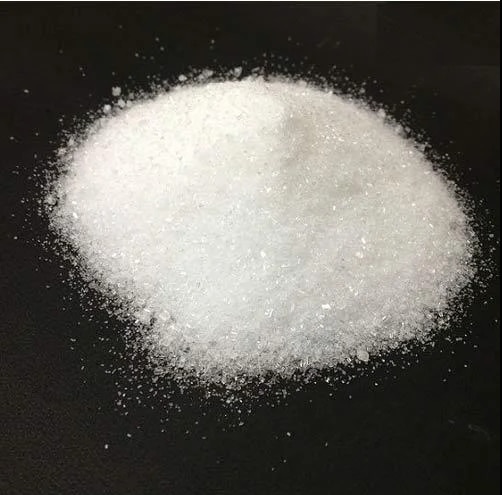 | Pharmaceutical Grade : USP CAS : 813-94-5 Molecular Formula : C12H10Ca3O14 Molecular Weight : 498.4 g/mol View product → |
Frequently asked questions
Why must processors confirm the calcium citrate hydrate before comparing price?
Anhydrous calcium citrate and calcium citrate tetrahydrate have different molecular weights, assay bases and calcium content. Compare quotations only after the supplier names the exact form.
What should a pharmaceutical-grade calcium citrate approval specification include?
Define identity, assay basis, calcium content, water or loss on drying, impurity limits, microbiological requirements and the test methods used for release.
How should you audit a calcium citrate certificate of analysis?
Check the product name, hydrate form, batch number, manufacturing date, test methods, specification limits, reported results, retest or expiry date and authorised approval.
What packaging and traceability details belong in a bulk calcium citrate order?
Specify pack size, food- or pharmaceutical-contact suitability, inner liner, tamper evidence, palletisation, batch identification, labels and documents linking each pack to its certificate.
How do you qualify a calcium citrate supplier for your process?
Evaluate repeat-lot consistency, documentation, packaging performance, delivery controls and process results rather than approving a supplier from one sample alone.
Keywords