Metal ions that appear in trace quantities can accelerate oxidation, create deposits, change colour and interfere with analytical results. By the end, you will know where disodium EDTA improves a process, when another treatment is better, how to choose between grades and hydration states, and what to verify before accepting a shipment.
Key takeaways
- Use disodium EDTA to bind trace metals that drive oxidation and precipitation.
- Choose the salt form with pH, temperature and solubility requirements in mind.
- Match LR, AR or compendial grade to the process and test specification.
- Check identity, assay, batch details and packaging before releasing material to production.
How disodium EDTA improves a chemical process
Trace metal ions can turn a stable process stream into a reactive one. Disodium EDTA binds calcium, magnesium, iron, copper and other multivalent ions into soluble chelate complexes, reducing their ability to catalyse oxidation, discoloration, rancidity, decomposition or unwanted precipitation.
| Metal or condition | Process problem | What disodium EDTA does |
|---|---|---|
| Iron and copper traces | Oxidation, colour change or rancidity | Holds catalytic ions in stable complexes |
| Calcium and magnesium | Hardness deposits or metal-ion precipitation | Keeps chelated ions available in solution |
| Residual metal contamination | Unreliable tests or formulation instability | Controls the interfering ions before analysis or filling |
Common edta disodium salt chemical uses include hardness testing, electroplating and metal-finishing baths, textile and pulp processing, detergents, cosmetics and pharmaceutical formulations. In a cleaning or rinse formulation, it supports removal of metal contamination; in a cream, solution or drug product, it can improve oxidative stability and preservative performance.
It does not replace a validated antimicrobial-preservative system or a stability study.
These are practical edta disodium salt benefits chemical processing in Vadodara can gain, but chelation has limits. EDTA does not remove suspended solids, oils or non-chelatable contaminants, so filtration or another separation step may still be needed. It is not a universal scale remover when strong alkalinity, carbonate dissolution or rapid acid descaling is required.
Do not substitute calcium disodium EDTA, a different therapeutic chelate, for ordinary disodium EDTA.
Choose the salt form and operating conditions together
Do not choose disodium EDTA by assay alone. Match its hydration state and salt form to the stream’s pH, temperature, mixing and contact time; otherwise a correct dose can leave metal ions uncontrolled.
| Form | Identity | Process consequence |
|---|---|---|
| Disodium, anhydrous | CAS 139-33-3 | Adds no crystal water; use the specification’s stated assay basis when calculating dose. |
| Disodium, dihydrate | CAS 6381-92-6 | Contains water of crystallisation; account for it in weighing and concentration calculations. |
| Tetrasodium EDTA | Different salt form | Dissolves with greater alkalinity; useful when the formulation tolerates a higher starting pH, but not interchangeable with disodium EDTA. |
Low pH protonates more of the EDTA molecule, reducing the ligand available to bind calcium, magnesium, iron and copper. Test the actual operating pH rather than assuming that the same nominal concentration gives the same chelation in an acidic, neutral or alkaline stream. Excess alkalinity can also change solubility and formulation behaviour.
Dissolve the powder completely, provide enough agitation for uniform contact, and verify performance at the process temperature and residence time. A short contact period, cold solution or competing metal load can make a laboratory dose fail in production.
These checks matter across EDTA disodium salt chemical uses, from analytical solutions and cleaning rinses to metal-finishing baths and pharmaceutical formulations; each application has different impurity and pH limits. It is not a substitute for filtration, corrosion control or rapid acid descaling.
Match LR, AR and compendial grades to the actual task
LR is suitable for routine laboratory preparation and process checks; AR is the better choice when trace-metal or assay accuracy matters. The benefits of EDTA disodium salt depend on matching that impurity control to the task, not choosing the highest-sounding label.
Grade and hydration state should be selected together:
| Grade or use | Suitable choice | What to verify |
|---|---|---|
| Routine industrial baths, detergents, textile, pulp and paper | Industrial or technical grade; anhydrous or dihydrate | Application limits, assay basis, insolubles, iron, copper and other listed impurities |
| Water-hardness testing and analytical solutions | AR; use the hydration state specified by the method | CAS number, assay basis, standardisation instructions and CoA results |
| Routine laboratory work and in-process checks | LR | Method suitability, assay, insoluble matter and trace-metal limits |
| Pharmaceutical or cosmetic formulation | Compendial or customer-approved grade, commonly the specified dihydrate or anhydrous form | USP, BP, Ph. Eur. or customer monograph, residual limits, microbiological requirements and stability data |
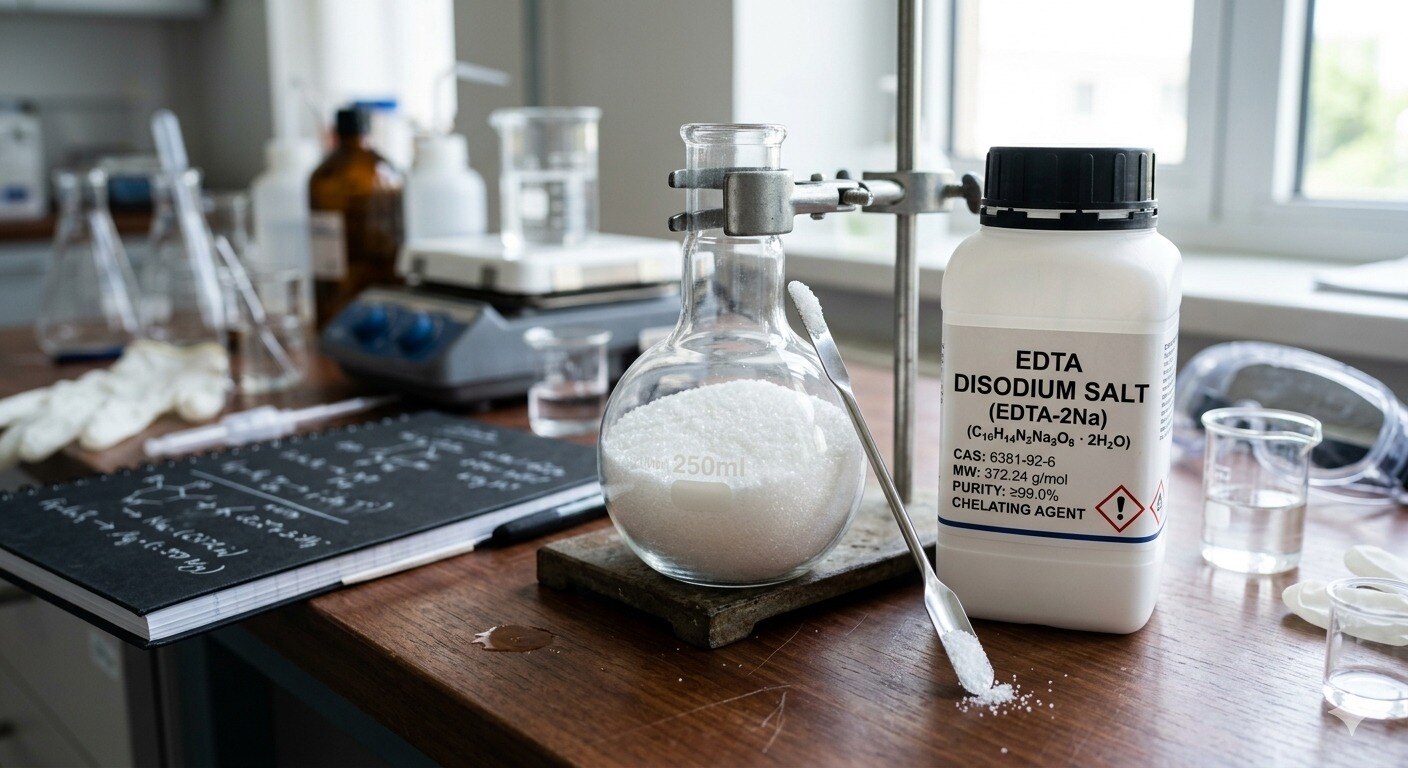
Anhydrous disodium EDTA is commonly identified as CAS 139-33-3; the dihydrate is commonly CAS 6381-92-6. Their molecular masses differ, so weighing the same mass does not deliver the same molar concentration. Confirm the CAS number, water content and assay basis on the specification and certificate of analysis before changing suppliers or hydration state.
Do not substitute calcium disodium EDTA for disodium EDTA, or reverse them, in a formulation or medical application. They are different chelates.
Check the material before use and protect it in storage
Verify the identity before opening the bag: anhydrous disodium EDTA is commonly CAS 139-33-3, while the dihydrate is commonly CAS 6381-92-6. A label reading only EDTA disodium salt leaves the hydration state, assay basis and dosing calculation unresolved.
- Match the label, purchase order and CoA for CAS number, anhydrous or dihydrate form, assay, moisture, appearance and retest date.
- Confirm the grade, intended application, particle or mesh requirement, package size and seal condition; reject wet, caked or damaged packs.
- Check that the CoA names the customer or regulatory standard you need, rather than assuming LR or AR grade satisfies a pharmaceutical or process specification.
- Recalculate additions on a molar or active-EDTA basis when changing hydration state. Equal weights of anhydrous and dihydrate material do not provide equal moles.
The phrase edta disodium salt lr ar benefits cannot replace these checks. LR and AR labels describe a grade; they do not confirm suitability for every formulation or analytical method. Do not substitute calcium disodium EDTA, which is a different chelate.
Handle the powder under local exhaust with gloves, eye protection and dust control. Keep the original container tightly closed, dry and off the floor.
Prepare solutions with measured water and record concentration, hydration basis, pH and preparation date. Use a clean, labelled container, protect the solution from contamination and follow your validated hold time; do not assume a stored solution remains fit indefinitely.
Turn a Vadodara purchase into a controlled process trial
Do not approve a trial from the label “EDTA disodium salt LR/AR” alone. Give an EDTA disodium salt supplier in Vadodara the exact CAS number, hydration state, assay basis, intended application, grade, particle or mesh requirement, pack size, retest period, CoA limits and customer or regulatory standard.
1. Confirm whether you need anhydrous disodium EDTA, CAS 139-33-3, or disodium EDTA dihydrate, CAS 6381-92-6. Check that the invoice, label and CoA state the same form.
2. Request assay, moisture or loss on drying, pH of a defined solution, insoluble matter, identification, and limits for iron, copper, lead and other relevant metals. Ask the EDTA disodium salt manufacturer in Gujarat to provide a representative batch CoA, not a generic specification sheet.
3. Run a bench trial at the proposed concentration and process temperature. Record dissolution time, solution clarity, pH change, filtration behaviour and any precipitate.
4. Compare matched batches with and without EDTA. Measure the outcome that matters: colour, oxidation markers, metal content, product assay, deposit formation or formulation stability.
5. Repeat the test with at least one production-representative batch, then set acceptance limits before scale-up. Halogens can support this comparison by supplying a defined grade and documentation, but your process data must decide approval.
The EDTA disodium salt benefits chemical processing in Vadodara only when its hydration state, impurities, dose and chelation performance match the process. A successful jar test does not replace a controlled pilot run.
Related product
 | Speciality Chemicals EDTA Disodium Salt LR/AR/IP/BP/USP/ACS EDTA disodium salt, also known as ethylenediaminetetraacetic acid disodium salt, is a chemical compound that belongs to the class of chelating... View product → |
Frequently asked questions
How does disodium EDTA improve a chemical process?
It chelates calcium, magnesium, iron, copper and other multivalent ions, reducing metal-driven oxidation, discoloration, decomposition and unwanted precipitation.
Which operating conditions matter when choosing disodium EDTA?
Review pH, temperature, water solubility, metal-ion load, contact time and the required dosage together with the salt form.
What is the difference between LR, AR and compendial EDTA disodium salt?
LR suits routine laboratory work, AR requires tighter analytical control, and compendial grade must meet the named pharmacopoeial monograph. Select the grade from the actual method or product specification.
What should you check before using and storing disodium EDTA?
Verify the product name, grade, assay, batch number, manufacturing and expiry details, certificate of analysis, intact packaging and storage instructions before use.
Keywords